


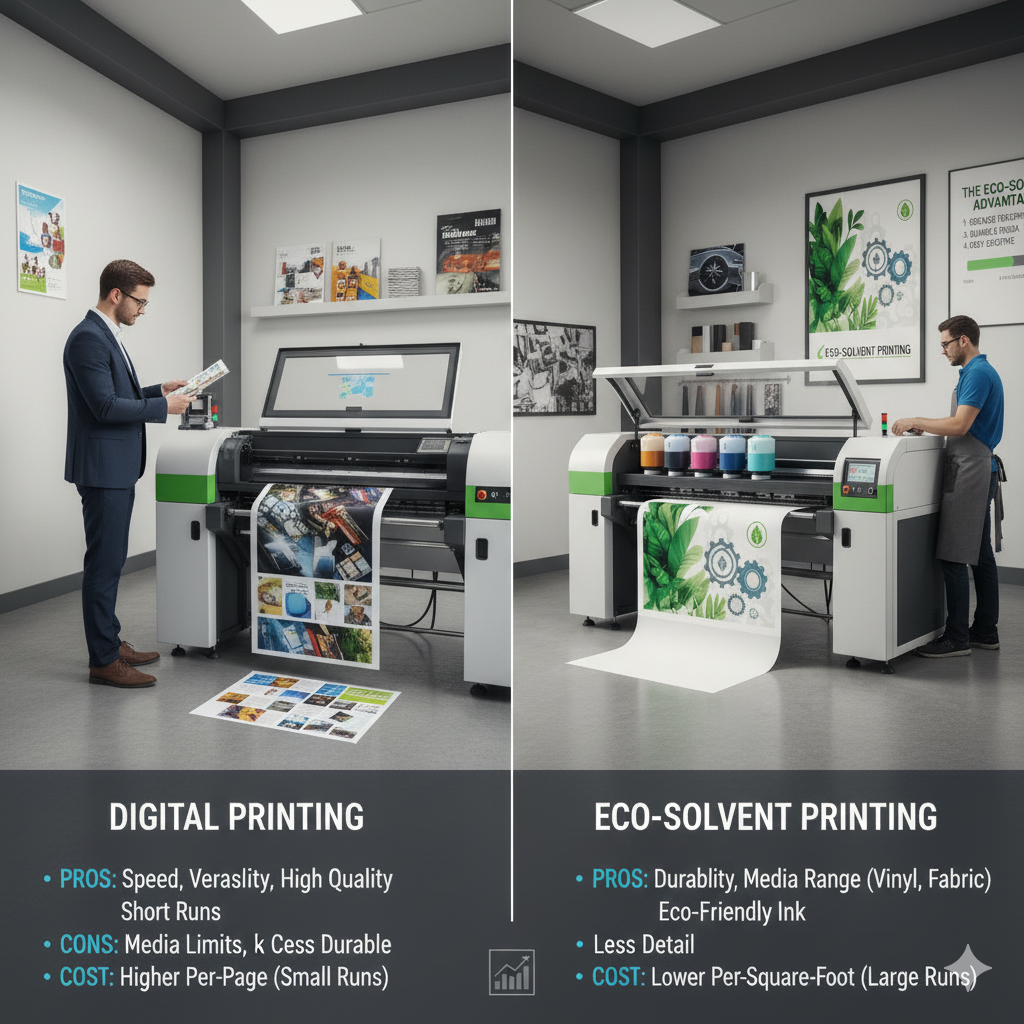
Solvent vs. Eco-Solvent Printing: Pros, Cons, and Cost Analysis (Complete Guide)
If you’re in the large-format printing or signage business, choosing between solvent printing and eco-solvent printing can directly impact your costs, output quality, and environmental footprint. Whether you run a print shop, advertising agency, or startup, understanding these technologies is essential for long-term success.
In this comprehensive, SEO-optimized guide, we’ll break down everything you need to know—differences, advantages, disadvantages, cost comparison, and best use cases—so you can make the right decision.
What is Solvent Printing?
Solvent printing uses oil-based inks containing strong chemical solvents that dissolve the surface of the material (like vinyl or PVC) and embed pigment deeply into it. (Inkmall Tech Co)
Key Characteristics:
-
High VOC (Volatile Organic Compounds) emissions
-
Strong odor (requires ventilation systems)
-
Excellent durability and outdoor resistance
-
Works on a wide range of materials
Solvent printing is widely used for:
-
Billboards
-
Outdoor signage
-
Vehicle wraps
-
Hoardings
These prints can last 3–7 years outdoors without lamination. (jardcreative.com)
What is Eco-Solvent Printing?
Eco-solvent printing uses refined, biodegradable solvent inks with lower VOC emissions. (Inkmall Tech Co)
Key Characteristics:
-
Low odor and safer for indoor use
-
Reduced environmental impact
-
High-resolution output
-
Moderate durability
Eco-solvent printing is ideal for:
-
Indoor branding
-
Retail graphics
-
Posters and decals
-
Short-to-medium term outdoor signage
Typical lifespan: 2–3 years outdoors (without lamination) (dimix.com)
Solvent vs. Eco-Solvent Printing: Key Differences
| Feature | Solvent Printing | Eco-Solvent Printing |
|---|---|---|
| Ink Type | Strong chemical solvent | Mild, eco-friendly solvent |
| VOC Emissions | High | Low |
| Odor | Strong | Minimal |
| Durability | 3–7 years | 2–3 years |
| Print Quality | Moderate | High (better resolution) |
| Indoor Use | Not suitable | Suitable |
| Environmental Impact | High | Lower |
| Cost per Print | Lower | Slightly higher |
Pros and Cons of Solvent Printing
Advantages
1. Extreme Durability
Solvent prints are highly resistant to UV, water, and abrasion, making them ideal for harsh outdoor conditions. (jardcreative.com)
2. Cost-Effective for Bulk Printing
Solvent printing is generally cheaper per square foot, especially for large-scale outdoor advertising. (WER-CHINA)
3. Wide Material Compatibility
Can print on:
-
Vinyl
-
Flex banners
-
PVC
-
Mesh
4. No Lamination Required
Due to strong adhesion, prints often don’t require lamination, reducing additional costs.
Disadvantages
1. Environmental and Health Risks
Solvent inks release harmful VOCs, contributing to air pollution and health hazards. (Clash Graphics)
2. Strong Odor
The smell makes it unsuitable for indoor environments. (Inkmall Tech Co)
3. Ventilation Costs
Requires:
-
Exhaust systems
-
Air filtration
-
Compliance with safety regulations
4. Lower Print Resolution
Compared to eco-solvent, print quality is often lower (especially for detailed graphics).
Pros and Cons of Eco-Solvent Printing
Advantages
1. Environmentally Friendly
Eco-solvent inks emit fewer VOCs, making them safer for operators and the environment. (SmartBuy)
2. Low Odor
Minimal smell allows printing in offices or indoor studios. (Chromoink)
3. High Print Quality
Produces sharp, high-resolution images suitable for branding and retail graphics. (jardcreative.com)
4. Versatility
Compatible with a wide range of media including:
-
Vinyl
-
Canvas
-
Fabric
-
Paper (Chromoink)
5. Lower Operational Costs (Long-Term)
Reduced need for:
-
Heavy ventilation
-
Complex safety systems (SmartBuy)
Disadvantages
1. Higher Initial Cost
Eco-solvent printers and inks can be more expensive upfront. (Make Me Sustainable)
2. Lower Durability
Outdoor lifespan is shorter than solvent printing. (dimix.com)
3. Slower Drying Time
Compared to UV or latex printing technologies. (SmartBuy)
4. Maintenance Requirements
Printers require regular cleaning to prevent clogging. (SmartBuy)
Cost Analysis: Solvent vs. Eco-Solvent Printing
Let’s break down the real cost factors:
1. Initial Investment
| Cost Factor | Solvent | Eco-Solvent |
|---|---|---|
| Printer Cost | Lower | Higher |
| Setup Cost | High (ventilation) | Low |
| Installation | Complex | Simple |
👉 Eco-solvent machines may cost more initially, but solvent setups require expensive ventilation systems, balancing the equation.
2. Ink Cost
-
Solvent Ink: Cheaper per liter
-
Eco-Solvent Ink: More expensive but efficient
👉 Eco-solvent inks often consume less and waste less, making them cost-effective over time. (SmartBuy)
3. Maintenance Cost
| Factor | Solvent | Eco-Solvent |
|---|---|---|
| Maintenance | Medium | Medium |
| Health/Safety | High | Low |
| Downtime | Low | Moderate |
Eco-solvent printers may require more frequent cleaning, but solvent systems incur hidden safety and compliance costs.
4. Operating Cost (Per Print)
-
Solvent printing = Lower cost per sq. ft.
-
Eco-solvent printing = Higher but premium quality
5. Total Cost of Ownership (TCO)
Over time:
-
Solvent printing = cheaper for large outdoor jobs
-
Eco-solvent printing = better ROI for indoor + branding work
Use Case Comparison
Choose Solvent Printing If:
-
You produce large outdoor banners
-
You need long-term durability (5+ years)
-
You operate in industrial environments
-
Budget is a primary concern
Choose Eco-Solvent Printing If:
-
You focus on indoor branding
-
You need high-quality graphics
-
You want low environmental impact
-
You run a small-to-medium print business
Industry Trends (SEO Insight)
The printing industry is shifting toward eco-friendly technologies due to:
-
Environmental regulations
-
Customer demand for sustainability
-
Workplace safety improvements
Eco-solvent printing is rapidly gaining popularity as a balanced solution between quality, cost, and sustainability.
Final Verdict: Which One Should You Choose?
There’s no one-size-fits-all answer.
Choose Solvent Printing:
✔ For heavy-duty outdoor advertising
✔ When durability matters most
✔ When working on tight budgets
Choose Eco-Solvent Printing:
✔ For premium indoor graphics
✔ For safer, eco-conscious operations
✔ For better print quality
Conclusion
Both solvent and eco-solvent printing have their place in the industry. Solvent printing dominates long-term outdoor applications, while eco-solvent printing leads in quality, safety, and sustainability.
If you’re starting or scaling a printing business in India or globally, a hybrid approach—using both technologies—can maximize profitability and flexibility.
FAQs
1. Is eco-solvent printing completely eco-friendly?
No. It emits fewer VOCs but still has some environmental impact. (Chromoink)
2. Which is cheaper: solvent or eco-solvent?
Solvent is cheaper per print, but eco-solvent may be more cost-effective long-term.
3. Can eco-solvent prints be used outdoors?
Yes, but they last 2–3 years compared to solvent prints. (dimix.com)
4. Do eco-solvent printers need ventilation?
Basic ventilation is recommended, but not heavy industrial systems. (SmartBuy)


