


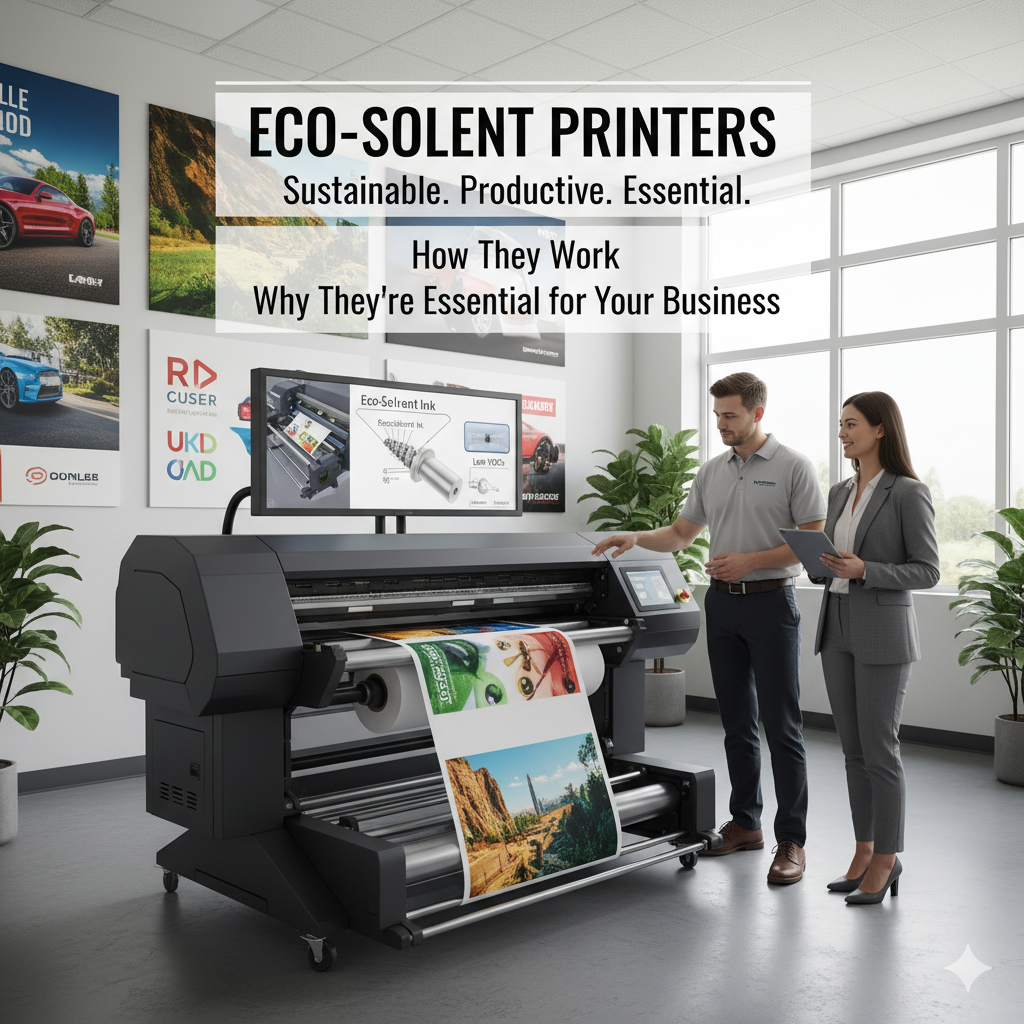
Introduction
In today’s fast-paced printing industry, companies are under increasing pressure to deliver high-quality prints while controlling costs and meeting sustainability demands. Clients expect vibrant visuals, brands demand long-lasting durability, and regulators push for greener technologies. Among the many printing innovations, eco-solvent printing has emerged as a game-changing solution that strikes a balance between performance, cost efficiency, and environmental responsibility.
The technology, powered by eco-solvent inks, has rapidly grown from a niche alternative to a mainstream choice across signage, retail, apparel, packaging, and promotional industries. According to industry research, the global eco-solvent printer market was valued at USD 1.02 billion in 2024 and is projected to reach USD 1.41 billion by 2031, growing at a CAGR of 5.1%. Similarly, the eco-solvent ink market is forecasted to hit USD 725 million by 2030, proving that this is not just a passing trend but a critical industry shift.
This comprehensive guide will walk you through everything you need to know about eco-solvent printers: how they work, their advantages, applications, comparisons with other technologies, best practices, and why they are essential for businesses of all sizes.
1. Understanding Eco-Solvent Printing
What is Eco-Solvent Printing?
Eco-solvent printing is a digital printing process that uses environmentally friendly solvent-based inks. Unlike traditional solvent inks that emit harmful volatile organic compounds (VOCs) such as toluene or acetone, eco-solvent inks are designed with milder carriers that are less toxic, safer to handle, and significantly better for the environment.
These inks still dissolve pigments into the surface of materials like vinyl, PVC, polypropylene, and canvas, but they do so with reduced emissions and without the harsh odors typically associated with solvent-based printing.
How It Differs from Traditional Solvent Printing
- Traditional Solvent Printing: Uses aggressive chemicals, requires highly ventilated spaces, and often exposes operators to strong fumes. While prints are durable outdoors, the process has a heavy environmental footprint.
- Eco-Solvent Printing: Uses gentler solvents, produces far fewer VOCs, and offers excellent print quality with both indoor and outdoor durability.
The rise of eco-solvent inks was driven by the industry’s need for sustainable alternatives that do not sacrifice performance. Today, eco-solvent printing is widely seen as the “balanced choice” between environmental safety, cost efficiency, and durability.
2. How Eco-Solvent Printers Work
Though eco-solvent printers share similarities with standard inkjet printers, their inks and printheads are specially engineered for durability and versatility. Here’s a step-by-step breakdown:
Step 1: Design Preparation
Designs are created in software such as Adobe Illustrator, CorelDRAW, or Photoshop, then processed through a RIP (Raster Image Processor). RIP software is critical because it translates complex color data, ensures accuracy, and optimizes ink usage.
Step 2: Ink Delivery
Eco-solvent inks are stored in cartridges or bulk systems. The slightly solvent-based composition allows pigments to penetrate and bond with coated surfaces such as vinyl and PVC films.
Step 3: Printing
The printer sprays microscopic ink droplets onto the substrate. Advanced printheads achieve resolutions of 720 dpi to 1440 dpi, ensuring sharp details and vivid colors.
Step 4: Drying and Curing
Unlike UV printing (which requires curing lamps), eco-solvent inks air-dry naturally or with gentle heat. This reduces energy consumption by up to 40–50% compared to UV-curing systems.
Step 5: Finishing
For added protection, prints can be laminated to extend outdoor durability from 3–5 years unlaminated to up to 10 years with lamination.
3. Advantages of Eco-Solvent Printers
a) Environmentally Friendly
Eco-solvent inks contain significantly fewer VOCs. Studies show traditional solvent inks release 50–60% volatile components, accounting for 70–80% of printing emissions, while eco-solvent alternatives cut these drastically. The result is healthier workplaces, greener operations, and regulatory compliance.
b) High-Quality Output
- Resolutions up to 1440 dpi deliver sharp images.
- Smooth gradients, vivid colors, and excellent saturation rival or exceed solvent and latex outputs.
- Perfect for both indoor (fine art, displays) and outdoor (banners, hoardings) applications.
c) Versatility Across Media
Eco-solvent inks adhere to a wide range of materials, including:
- Vinyl
- PVC
- Polypropylene
- Canvas
- Heat transfer paper
This flexibility allows businesses to expand into signage, vehicle graphics, interior décor, and even apparel customization.
d) Durability
Eco-solvent prints are water-resistant, fade-resistant, and scratch-resistant. Outdoor lifespan averages 3 years unlaminated and 7–10 years laminated, making them reliable for demanding environments like vehicle wraps and outdoor billboards.
e) Cost Efficiency
- Reduced ink waste due to precise droplet control.
- Lower maintenance costs because eco-solvent inks are less corrosive and clog nozzles less often.
- Energy savings from ambient drying.
- Many shops report 20–25% lower production costs compared to older solvent systems.
f) Low Maintenance
Eco-solvent printers require less frequent cleaning and produce fewer printhead blockages, translating into higher uptime and lower service costs.
4. Applications of Eco-Solvent Printing
Eco-solvent technology’s versatility means it’s used across industries:
a) Signage
- Retail banners and hoardings
- Point-of-sale displays
- Trade show graphics
- Directional and safety signs
b) Vehicle Graphics
- Car wraps and decals
- Bus and truck branding
- Fleet graphics for logistics and delivery services
c) Promotional Products
- Custom stickers and labels
- Branded merchandise like mugs, bottles, T-shirts
- Event giveaways and corporate branding
d) Interior Design
- Wall murals and custom wallpapers
- Office branding graphics
- Canvas art reproductions
- Retail display décor
e) Packaging
- Flexible packaging films
- Custom labels for FMCG
- Branding for food, beverage, and consumer goods
Case Example:
A mid-sized signage company in Mumbai switched from solvent to eco-solvent printers in 2022. By doing so, they reduced VOC emissions by 60%, cut electricity costs by 18% (thanks to no curing lamps), and attracted eco-conscious retail clients — growing revenues by 22% within a year.
5. Choosing the Right Eco-Solvent Printer for Your Business
When selecting a printer, consider these critical factors:
Print Width and Speed
- 24–30 inch models → Ideal for small shops producing decals and labels.
- 54–64 inch wide-format models → Suitable for banners, hoardings, and vehicle wraps.
- Production speed matters: High-volume businesses should opt for printers that can output 20–30 sq. meters/hour or more.
Ink Compatibility
- Standard CMYK inks are sufficient for most jobs.
- Extended color sets (Light Cyan, Light Magenta, White, Metallic) enhance quality for photographic and specialty prints.
Resolution
A minimum of 720 dpi is required for commercial work. For photographic detail and art prints, 1440 dpi is preferred.
Media Handling
Evaluate thickness capacity, roll-to-roll capability, and compatibility with specialty substrates.
Budget and ROI
- Entry-level eco-solvent printers: USD 6,000–12,000.
- Wide-format, industrial-grade units: USD 20,000–40,000.
While upfront costs are higher than traditional solvent printers, most businesses report ROI within 12–18 months due to lower running costs and new revenue opportunities.
6. Eco-Solvent Printing vs Other Printing Technologies
Here’s a detailed comparison to help you choose wisely:
| Feature | Eco-Solvent Printing | Solvent Printing | UV Printing | Latex Printing |
|---|---|---|---|---|
| Environmental Impact | Low VOC | High VOC | Minimal | Low VOC |
| Color Vibrancy | High | High | High | Medium |
| Media Compatibility | Vinyl, PVC, Canvas | Vinyl, PVC | Limited | Paper, Fabric |
| Outdoor Durability | 3–5 yrs (10 w/lam) | 5+ yrs | 3–5 yrs | 2–3 yrs |
| Cost Efficiency | Moderate | Moderate | High | Moderate |
| Maintenance | Low | Moderate | Low | Low |
| Energy Consumption | Low | Moderate | High | Medium |
Conclusion: Eco-solvent provides the best balance for businesses wanting quality, durability, and eco-friendliness without the high operational costs of UV.
7. Best Practices for Using Eco-Solvent Printers
To maximize lifespan and quality:
Regular Cleaning
Perform nozzle checks and clean printheads weekly to avoid clogging.
Use Quality Media
Investing in premium vinyl or canvas ensures proper ink adhesion and longer-lasting prints.
Proper Storage
Keep inks and media in cool, dry conditions to maintain stability.
Calibration
Calibrate color profiles regularly for consistent output, especially in multi-printer setups.
Training
Train operators in RIP software, color management, and preventive maintenance for smoother workflows.
FAQ: Do eco-solvent prints need lamination?
Not always. For short-term indoor use, lamination is optional. For outdoor signage, vehicle wraps, or applications needing 5+ years durability, lamination is strongly recommended.
8. Future of Eco-Solvent Printing
The future looks bright for eco-solvent technology:
- Market Growth: Expected to grow steadily at 5–7% CAGR globally until 2030.
- Sustainability Trend: As environmental regulations tighten, eco-solvent adoption will accelerate.
- Technology Advances: Printheads are becoming faster and more precise, RIP software is integrating AI-driven color calibration, and inks are being formulated for even lower VOC content.
- Regional Expansion: Asia-Pacific already holds 45% of the market, with India showing rapid adoption under green manufacturing subsidies.
Businesses that embrace eco-solvent printing now will gain a competitive edge by aligning with both consumer expectations and regulatory requirements.
9. Conclusion
Eco-solvent printing offers the perfect blend of quality, efficiency, and sustainability. From vibrant banners and vehicle wraps to long-lasting packaging and décor, eco-solvent printers help businesses expand offerings, reduce costs, and meet green standards.
If your goal is to stay competitive, eco-conscious, and profitable, investing in eco-solvent technology is no longer optional — it’s essential.
About MSSIGN Enterprises
MSSIGN Enterprises is a leading provider of eco-solvent printers, digital printing solutions, and printer spare parts. With a strong commitment to innovation, quality, and customer success, MSSIGN helps businesses achieve professional-grade printing results efficiently and sustainably. Explore our wide range of eco-solvent solutions and take your printing business to the next level.
Meta Details (SEO-Ready)
Meta Title: Eco-Solvent Printing Guide 2025: Benefits, Applications, and Market Insights
Meta Description: Discover everything about eco-solvent printing — how it works, its advantages, applications, industry stats, and why businesses should invest in eco-friendly printing technology.
10 Social Media Snippets
- 🌍 Go green without compromising on quality! Learn how eco-solvent printing is transforming the industry. #EcoSolvent #PrintingTrends
- 🚀 The global eco-solvent printer market is set to hit $1.4B by 2031. Is your business ready? #PrintIndustry #EcoFriendly
- 🎨 From vibrant signage to durable vehicle wraps — eco-solvent printers do it all. Discover how 👉 [Link]
- 📉 Cut costs by 20–25% while improving sustainability. Eco-solvent printing is the future of business printing. #SustainablePrinting
- 🖨️ Did you know? Eco-solvent prints can last up to 10 years with lamination. #PrintDurability #EcoSolvent
- 🌱 Lower VOCs, cleaner air, healthier workplaces. Eco-solvent = eco-smart. #GreenPrinting
- 🛍️ Expand your business into signage, décor, packaging & more with eco-solvent printers. Learn how 👉 [Link]
- 💡 Future-ready printing: AI-driven RIP software + eco-solvent inks = smarter workflows. #PrintInnovation
- 🚌 Fleet graphics, shop banners, custom stickers — one technology powers them all. #EcoSolventPrinting
- 📊 Market data shows eco-solvent inks growing at 7% CAGR. Don’t get left behind. #PrintingBusiness


